Healthcare RCM assistant for claim denial review.
A claim review workspace for teams that need faster denial triage while keeping appeal decisions under human review.
Healthcare RCM Assistant made the workflow easier to explain: the inputs, AI review, human handoff, and business action are all visible in one place.
— Product team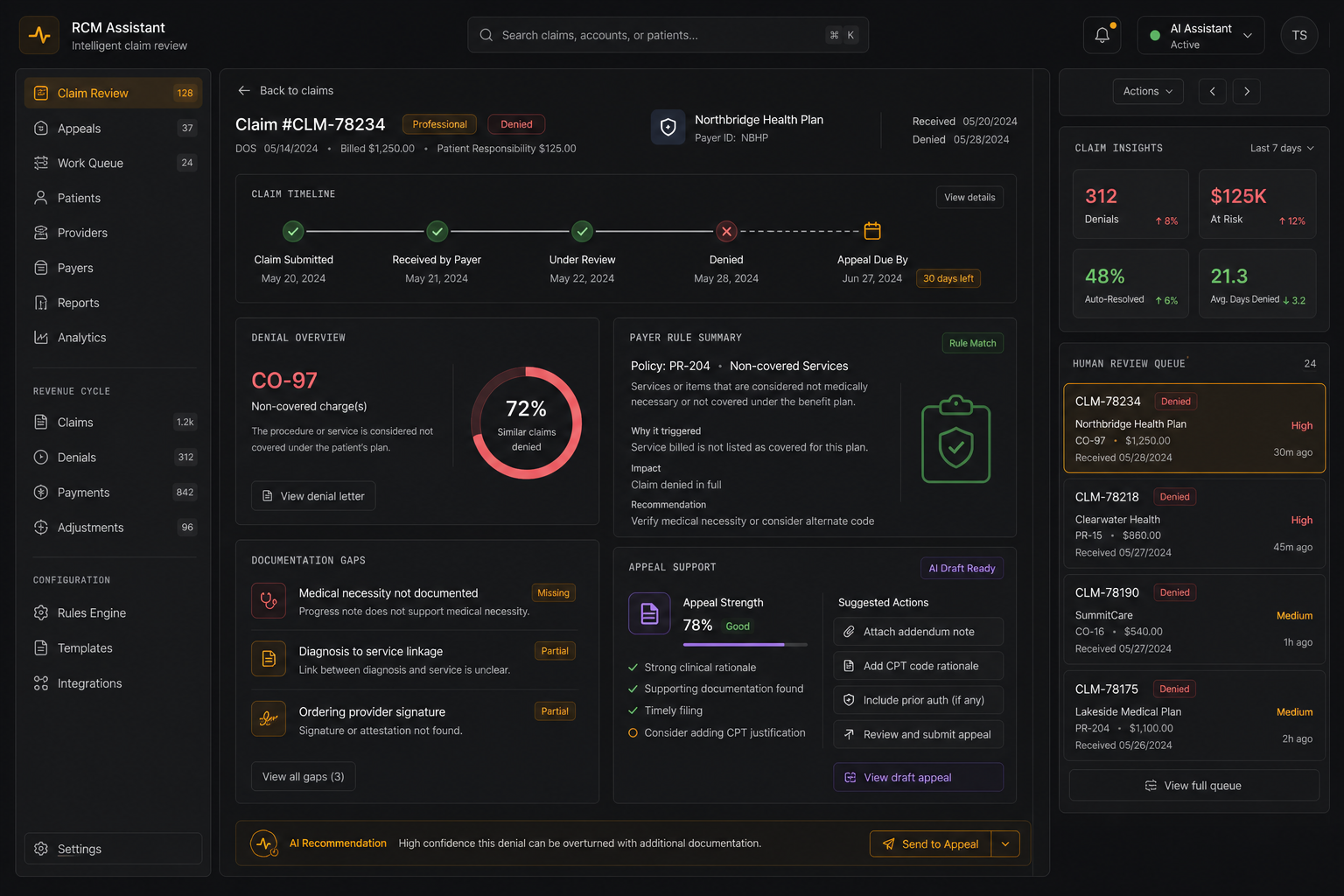
Reason codes organized
Relevant guidance summarized
Missing evidence surfaced
Reviewer edits before use
Claim denials require policy context, documentation review, and careful appeal judgment.
RCM teams need a way to see denial reasons, payer rules, missing evidence, and possible appeal notes without losing review control.
The workflow needed a visual and operational story that buyers can scan quickly: what comes in, what the AI does, what a human reviews, and where the result lands.
Claims involve regulated data and high-stakes financial outcomes.
The assistant must summarize the right rule for the denial context.
A useful review identifies what evidence is missing and why it matters.
Appeal drafts must remain editable support notes.
We designed the assistant around denial evidence and human review.
The visual shows a claim timeline, denial category, payer rule summary, documentation gaps, and appeal support notes in one workspace.
The project is framed around the business workflow itself: the source inputs, AI review, approval points, and final handoff are all visible in one story.
- Claim timeline with denial category.
- Payer rule summary and documentation gaps.
- Appeal support notes for reviewer editing.
- Human review queue for sensitive actions.
Timeline view
Claim history and denial events are shown before recommendations.
Rule summary
Payer guidance is visible beside the appeal opportunity.
Gap list
Documentation issues are separated from general notes.
Review queue
Sensitive actions are routed to a human owner.
Workflow audit
Mapped source inputs, users, review points, and the final business action.
AI task design
Defined classification, extraction, drafting, prediction, or detection responsibilities.
Human review path
Added approval, exception, and escalation points where judgment matters.
Product narrative
Turned the workflow into a clear buyer story for sales conversations, reviews, and handoff.
- Denial letter
- Claim history
- Payer rules
- Clinical docs
- Reason codes
- Timeline
- Eligibility
- Evidence gaps
- Rule summary
- Appeal notes
- Risk flags
- Next action
- Reviewer queue
- Draft packet
- Owner assignment
- Audit log
Healthcare RCM workflows need AI to organize evidence, not make unsupported appeal decisions.
Clearer product surface: Healthcare RCM Assistant now communicates the workflow through the actual review states, handoffs, and outcomes buyers care about.
Faster buyer clarity: the problem, workflow, proof points, and next action are easy to understand without a technical walkthrough.
Healthcare RCM Assistant made the workflow easier to explain: the inputs, AI review, human handoff, and business action are all visible in one place.
- Denial letter
- Claim history
- Payer rules
- Clinical docs
- Reason codes
- Timeline
- Eligibility
- Evidence gaps
- Rule summary
- Appeal notes
- Risk flags
- Next action
- Reviewer queue
- Draft packet
- Owner assignment
- Audit log
- Human review
- Audit trail
- Quality checks
- Fallback rules
Got a problem AI might solve? Let's find out.
30 minutes. Free. No NDA needed. You leave with a clear yes-or-no on whether to build — and a one-pager you can forward to your team the same day.